Hello and welcome to Eye on AI. In this edition…Nvidia becomes the first $5 trillion market cap company…Anthropic finds AI models have ‘introspection,’ of a kind…and Meta, Alphabet, and Microsoft tell investors just how much they’ve been spending on AI data centers.
Hello, it’s Jeremy here. I’m just back from Fortune Global Forum in Riyadh, where AI was very much a central feature in many of the discussions. I will provide a few insights from what I learned there.
Of course, there was a lot of discussion at the event about whether there’s an “AI bubble”—and that was before we got the latest earnings and cap ex numbers from Meta, Microsoft, and Alphabet. Wall Street’s disparate reactions to the companies’ quarterly report cards show the market’s growing impatience to see tangible results from hefty AI investments. They will only support companies who can show they are seeing notable revenue impact today.
Why the market reacted so differently to Meta’s, Microsoft’s, and Alphabet’s capex numbers
Consider Alphabet, which saw its shares climb after its earnings report. With its quarterly search revenues growing 14.5% year-over-year, and cloud revenues up 32%, Alphabet continues to defy concerns that AI poses an existential innovator’s dilemma to its core advertising-based business model. By contrast, Meta said capital expenses on AI data centers next year would be even larger than the already whopping $70 billion to $72 billion it’s spending this year as CEO Mark Zuckerberg races to build “super-intelligence,” an incredibly ambitious effort with limited immediate revenue impact. Investors weren’t having it, and Meta’s shares got hammered, dropping 9% in pre-market trading.
Investor reaction to Microsoft’s earnings fell somewhere between these two extremes. Like Alphabet, it reported revenue numbers that exceeded consensus analyst forecasts, but not by much, and it also said capital expenditures would climb more than analysts had anticipated. So it saw its shares slide about in line with investors’ disappointment in the size of the gap between revenue acceleration and capital expense growth, even though Microsoft’s cloud computing sales were up an impressive 40% from last year, a figure it largely attributed to AI spending.
What was striking at Fortune Global Forum, however, was how little global executives seemed to care about these financial market dynamics. If there was any consensus from the discussions in Riyadh, it was that the current moment is a lot like the early days of the internet or the roll out of cloud computing in the mid-2000s and early-2010s. In other words, a real technological transformation is underway. Yes, it might involve some companies becoming overvalued—as did happen with the internet boom. But almost all agreed that AI is going to have a transformative and lasting impact on their companies, and on the world economy, even if there is a market correction.
Executives are finding value in AI
At an IBM-sponsored dinner at FGF that Fortune hosted, Ana Paula Assis, IBM’s senior vice president and chair for EMEA and growth markets, said that, in her experience, it wasn’t the fear of an AI bubble—the concern that AI might just be a flash in the pan that doesn’t live up to the hype—that held companies back from investing in the technology. Instead, it was the speed of AI innovation that was actually the problem. Some companies, she said, seemed worried they would build systems around one set of models and capabilities, only to have those eclipsed in just a few months or a year, requiring them to change those workflows and swap models again. She described some potential customers as “like deer in the headlights” dazzled and frozen in place by the pace of change.
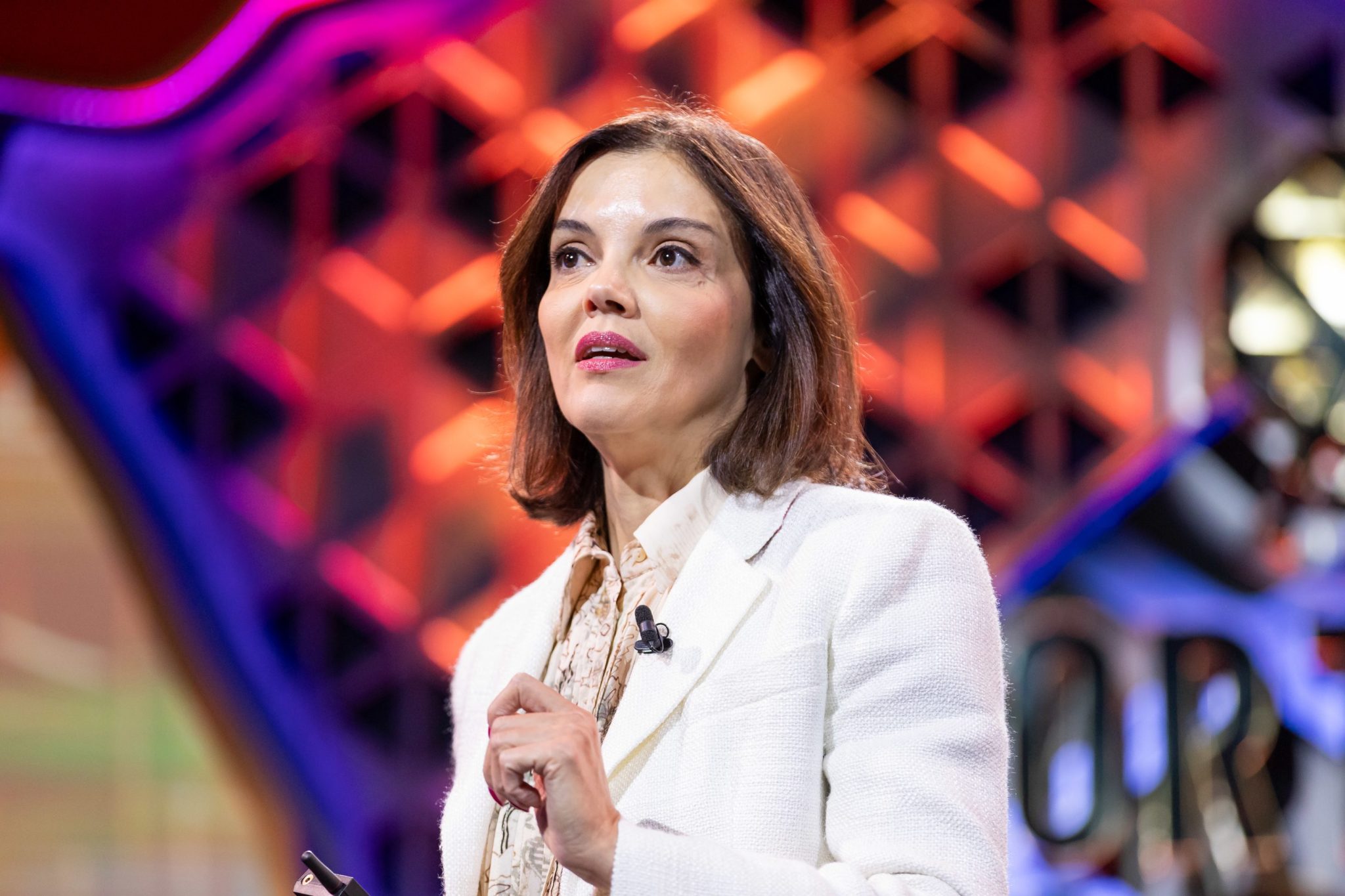
On stage at the conference, Ruth Porat, the president and chief investment officer at Alphabet, echoed Assis’s view to some degree. She noted that there was a big disparity between the speed of AI advances and the speed at which companies were adopting the technology. She said this disparity was largely the result of how difficult it is for large enterprises to change internal processes in general. And to get the most out of AI requires companies to rethink every process, she said, so it is perhaps not surprising that this is happening much more slowly than the rate at which AI companies, including Google, are rolling out new AI models and capabilities.
IBM put out some survey results this week for EMEA enterprises that show companies are indeed moving ahead with deploying AI at scale. Its survey of 3,500 senior executives in 10 countries found that two-thirds reported “significant productivity gains” from deploying AI. In some sectors, such as finance, the figure was 72%. Adoption in Saudi Arabia was even higher still—84%. What’s more, across EMEA, 92% of those surveyed were confident that AI agents would deliver ROI within the next two years. (Which may prove the point about the tech capabilities running far ahead of adoption. You might remember how many top tech execs declared 2025 to be “the year of AI agents.” I guess the real year of AI agents might be 2027!)
Ok, with that, here’s more AI news.
Jeremy Kahn
jeremy.kahn@fortune.com
@jeremyakahn
FORTUNE ON AI
Character.AI bans teens from talking to its chatbots amid mounting lawsuits and regulatory pressure—by Beatrice Nolan
Everyone thinks AI is replacing factory workers, but Amazon’s layoffs show it’s coming for middle management first—by Eva Roytburg
Martin Sorrell says AI has already ‘missed the Oppenheimer moment’—by Allie Garfinkle
Longevity science is on the cusp of major breakthroughs thanks to AI, but significant ‘data gaps’ need to be filled, expert says—Alexei Oreskovic
AI is the common threat—and the secret sauce—for security startups in the Fortune Cyber 60—Alexei Oreskovic
AI IN THE NEWS
Nvidia becomes world’s first $5 trillion company as it reveals $500 million order backlog. The AI chip company became the first business ever to reach a $5 trillion market capitalization, after its shares rose earlier in the week following several announcements by its CEO and founder, Jensen Huang, at a developer conference in Washington, D.C. Huang revealed that the company has a $500 billion order backlog for its latest Blackwell GPUs and its upcoming Rubin GPUs. The company has also recently announced deeper partnerships and investments with OpenAI, Oracle, and Eli Lilly. Nvidia has seen its market cap add $3 trillion in value since early 2024. Read more from The Wall Street Journal here.
Fed Chair Powell says AI boom not comparable to dot com bubble. U.S. Federal Reserve Chair Jerome Powell said the current artificial intelligence boom differs from the dot-com bubble because today’s leading companies—and here he seems to have been referring to the likes of Nvidia, Alphabet, Microsoft, and Meta, as opposed to the AI model makers such as OpenAI and Anthropic—actually generate profits. He also noted that the AI boom is driving tangible economic growth through investments in data centers and chips. (Although it should be said that the dot com bubble also fueled capital investment in fiber optics and networking equipment.) He contrasted this with the 1990s internet frenzy, when many high-valued firms collapsed after failing to turn a profit. You can read more from CNBC here.
Anthropic says cutting-edge AI models may have a kind of introspection. The AI company said its Claude Opus 4 and 4.1 models exhibit early signs of introspection—the ability to detect and describe aspects of their own internal states rather than just generate plausible text. In experiments, Anthropic researchers “injected” specific neural activation patterns that they knew were associated with particular concepts into the model at times when it was not considering topics related to those concepts. It then asked the model whether it noticed anything different about its thinking in these instances. The models were able to correctly identify some of these “thoughts” as not their own some of the time, indicating a limited form of self-monitoring, according to the Anthropic researchers. This introspective behavior, however, was highly inconsistent—occurring only about 20% of the time—and its underlying mechanisms remain unclear. Anthropic cautions that while intriguing, these findings do not imply human-like self-awareness but could help advance future work on model transparency and interpretability. You can read more in Anthropic’s blog post on the research here.
Study finds top AI models can’t construct predictive “world models.” A group of researchers from the non-profit AI lab the Basis Research Institute and affiliated with MIT, Harvard University, the University of Montreal, the University of Cambridge and Cornell University, built a new benchmark to test how leading LLMs perform at tasks that require understanding a virtual world, including discovering links between cause and effect and the “rules” by which the world operates. Their new “AutumnBench” involves a suite of 43 grid-world environments with 129 tasks, including predicting which objects are behind an obstruction, planning, and detecting what’s changed in a scene and the likely cause. They looked at how three state-of-the-art reasoning models— Anthropic’s Claude 4 Sonnet, Google’s Gemini 2.5 Pro, and OpenAI’s o3—compared against 517 human participants. They allowed the test subjects to spend some time exploring each virtual world and deploying strategies to figure out the rules of the world before testing them on the tasks. The results show that humans significantly outperform the AI models across all task types and environments. What’s more, they found that the models fail to adopt human-like strategies for determining the rules of the virtual worlds and how to perform the tasks, such as hypothesis-testing and updating their beliefs to account for new evidence. You can read the research paper here.
AI CALENDAR
Nov. 10-13: Web Summit, Lisbon.
Nov. 26-27: World AI Congress, London.
Dec. 2-7: NeurIPS, San Diego.
Dec. 8-9: Fortune Brainstorm AI San Francisco. Apply to attend here.
EYE ON AI NUMBERS
$78.2 billion
That’s the amount that just Meta, Microsoft, and Alphabet collectively spent building new AI data centers and buying AI hardware in the three months between the end of June and the end of September. And all three companies signaled they plan to continue to ramp up that spending further over the next quarter and throughout 2026. You can read more here from the Financial Times.
Credit: Source link