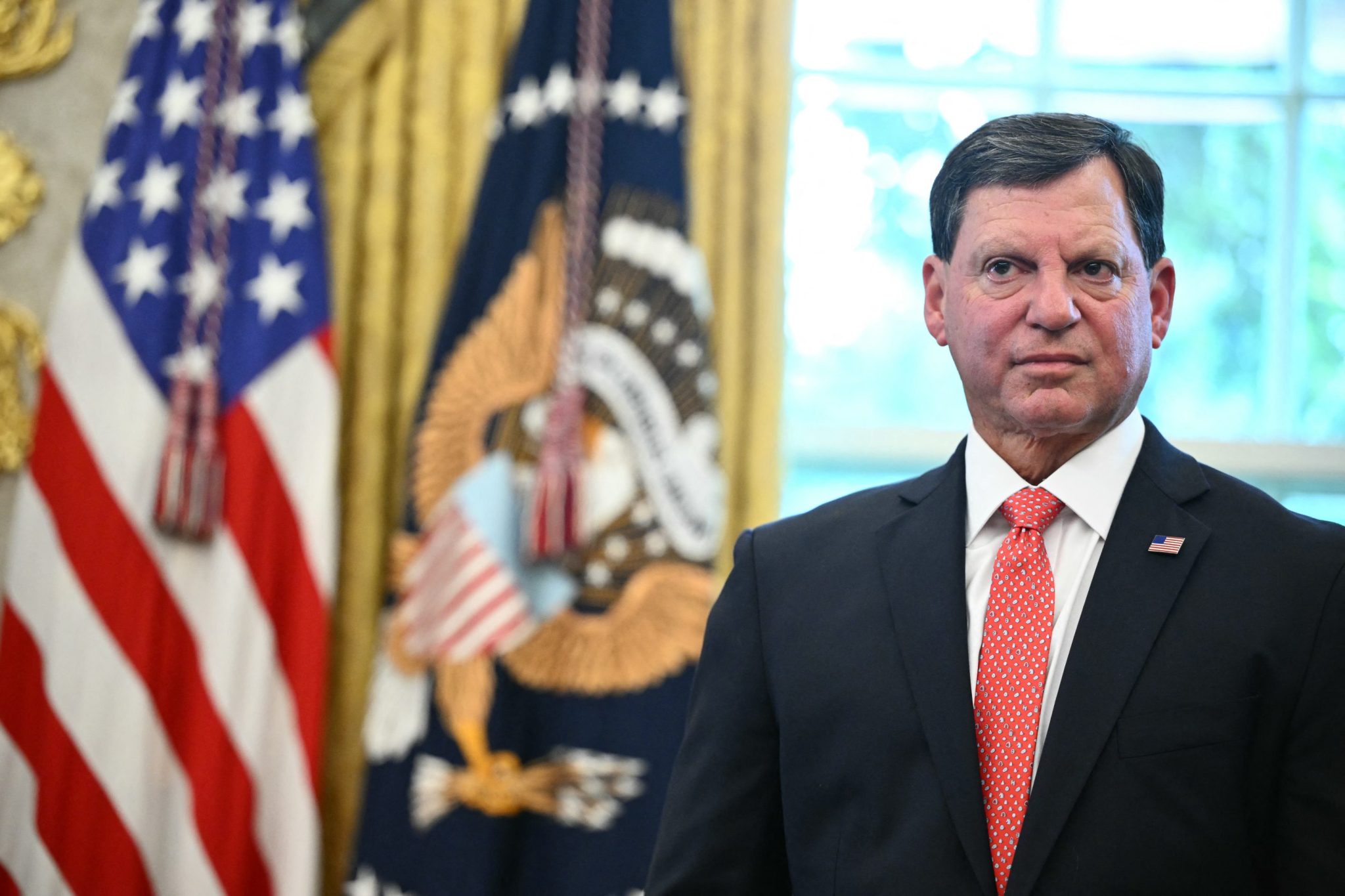
Frank Bisignano’s cell phone lit up, and he recognized the caller. The president was on the line. On this morning in early October, the newly confirmed Social Security commissioner was seated in his 40th floor office in Manhattan’s Tribeca that features a sweeping view of the lower East Side and on to Brooklyn, where he grew up in a blue-collar family to a father who spent 44 years as a customs agent, and a mother who ran a stevedoring outfit. “The president and my boss, [Treasury Secretary] Scott Bessent were together in the Oval Office, and the president told me it was Scott’s recommendation that I also run the IRS as its first ‘CEO,’” recalls Bisignano. “I said, ‘Yes, I’ll do whatever you want,’ and the president said that he’s counting on me to ‘make the IRS great again,’ just as he’d charged me to do with Social Security.”
Those dual jobs make Bisignano probably the back-office administrator wielding the broadest authority in recent U.S. history. He now oversees both the largest retirement system in the world, which pays out $1.5 trillion a year to over 70 million beneficiaries, and a planet-topping revenue machine that collects over $5 trillion in annual taxes that fund over 90% of the federal government’s operations.
Bisignano is a phenomenon neither agency has seen in a long time, if ever; a former super-big-time private-sector CEO who’s running both agencies like they’re the kind of turnaround cases he’s made a career of fixing. He’s an operator, not a bureaucrat, and he’s bringing his restructuring skills to two areas that feature combined operating budgets of over $30 billion and workforces totaling around 150,000, and that famously need a big lift in efficiency and customer service. The likes of tardy tax refunds at the IRS, super-slow disability resolutions at the SSA, and long phone hold times at both agencies are among the most prominent failings that prod so many Americans into believing that government doesn’t work. None of his recent predecessors had significant experience running a big business.
By contrast, Bisignano is a Jamie Dimon protégé who built one of the top careers on Wall Street by constructing and streamlining unglamorous, tech-heavy but highly lucrative functions such as payments networks and treasury services, joining the administration after serving as CEO of credit card payments colossus Fiserv.
And filling double roles is nothing new to him. “People ask me, ‘How do you do two jobs?’ And I really don’t look at it like that,” Bisignano told Fortune on Jan. 18 during an exclusive interview, in the same corner office where he got the call from Trump. “At Citigroup, I was at one time deputy head of operations and tech, and also chief administrative officer of the world’s largest global and investment bank. Then, under Jamie at JPMorgan, I was co-COO of the company, and also oversaw the mortgage workout program resulting in the $26 billion federal settlement in 2012 that restarted the housing market.”
In an administration staffed by a number of former top business folks, including Commerce and Interior Secretaries Howard Lutnick and Doug Burgum, and Small Business Administration chief Kelly Loeffler, Bisignano is the figure who’s had by far the biggest jobs in the most prominent enterprises.
Now, Bisignano is bringing what he calls the same digital-first approach, deployment of rigorous KPIs for managers, and relentless team building to both agencies that he marshaled with such success in his previous life.
But the spotlight is now trained big-time on how he handles the coming tax season that promises a never before seen deluge of cash refunds, and big changes in the code that will make returns far more complicated than usual to process. Trump and Bessent keep proclaiming that the One Big Beautiful Bill means big cash back to taxpayers, and they realize that if the IRS screws up by delaying the bounty or shortchanging taxpayers by mistake, they’ll lose a lot of the goodwill they see coming their way.
Bisignano’s quick work at the SSA confounded even Elizabeth Warren, and points to major improvements at the IRS
Prior to Bisignano’s arrival, from December of 2023 until the current leader’s Senate confirmation of May 6, a parade of four SSA commissioners and acting commissioners cycled through the position. These chiefs departed fast in part because they got frequent hammerings in Congress over the agency’s poor phone and face-to-face service to beneficiaries. The list of metrics that have improved over his short tenure are impressive. First, the site is now running around the clock (previously it was down 29 hours a week or 17% of the time). Phone wait times have shrunk dramatically: In June of last year the average time on hold before speaking to an agent was 20 minutes, that shrunk to an all-time low of seven minutes in September. Meanwhile, the SSA phone service handled 68 million callers in fiscal year 2025, 67% more than in FY 2024. Bisignano maintained application and appeals processing during the government shutdown and offered overtime to work the days around Christmas, which are federal holidays; 66% of staff showed up. In another win, the commissioner orchestrated new workflows that reduced the time for processing disability claims from 240 to 209 days, and curbed the backlog to 865,000 from 1.26 million.
According to an SSA press release, at a meeting with Bisignano in July, Sen. Elizabeth Warren “expressed disbelief about the data” provided by the commissioner and his staff showing a quick, substantial reduction in wait times for callers on the national SSA 800 number. The legislator and commissioner agreed to an audit of the reported stats by the Office of the Inspector General. In a report published on Dec. 22, the OIG backed Bisignano, concluding: “The SSA’s publicly reported metrics were accurate, and its overall telephone performance improved during FY 2025.”
Bisignano rose as a “fixer” for Sandy Weill, Jamie Dimon, and Henry Kravis
The grandson of Italian immigrants, Bisignano attended Baker University, a liberal arts school in Kansas, where he won trophies as a nationally ranked bowler. In 1994, he got his first big break when Dimon hired him at Travelers to run securities operations at its Smith Barney unit. He captained a strutting softball team of Italian Americans who dubbed themselves “the Paisanos” and sported floppy hats, like those of pizza-makers, on the field. As Dimon and Weill rolled up the acquisitions en route to forming what would eventually tower as Citigroup, Bisignano’s role in IT grew, and by mid-2001, he was managing 16,000 workers in lower Manhattan.
As the Twin Towers burned on 9/11, Bisignano rushed to the street, megaphone in hand, and roared, “Walk north!” He then led a parade of thousands of Citi workers to an operations center near Penn Station, and kept the bank’s computers whirring during the weeks of chaos that followed.
In 2002 Bisignano took charge at a Citi backwater called Global Transactions Services that was then losing $3 billion a year. He reinvented GTS as a venue where multinationals could outsource forex services and accounting; just three years later, the franchise was generating over $1 billion in profit, and remains a major moneymaker for Citi to this day. In late 2005, the newly arrived Dimon lured Bisignano to JPMorgan as chief administrative officer, then enlisted this seasoned crisis manager to repair the foreclosure-laden mortgage portfolio at the former Washington Mutual, the subprime lender that JPM salvaged at the government’s behest during the Global Financial Crisis.
Bisignano jetted daily to California on the WaMu assignment, then headed back to New York each night to receive chemotherapy for throat cancer he believes may have resulted from inhaling toxic soot on 9/11. His trademark gravelly voice is a legacy of the surgery that made him a survivor. Bisignano also got Dimon’s nod to integrate another casualty, Bear Stearns, into the JPM fold. The deal cost $250 million, and for that price, JPM got all of Bear’s operations, plus the new, ultra-fancy, 47-story headquarters that cost $1.1 billion to build, and where the JPM brass decamped for years during the construction of their new hub on Park Avenue.
In 2013 KKR cofounder Henry Kravis, and then top manager and now co-CEO Scott Nuttall, recruited Bisignano to repair arguably the worst big investment the private equity giant ever made, stricken credit card payments processor First Data. Bisignano transformed the “dumb bricks” that only swiped cards into countertop terminals-cum-computers branded Clover, boasting analytical tools that helped manage inventories and inform managers which waiters were selling the priciest bottles of wine, and reminding them to offer the same vintages when the connoisseurs that ordered those labels last time returned. In 2019 Bisignano sold First Data to Fiserv, creating a giant generating over $20 billion a year in revenue that owns 6 million terminals worldwide and processes 44% of America’s credit card payments. Next came the calls from Trump who, along with Bessent, viewed the challenges at the SSA and IRS as right in the wheelhouse of the manager who’d been a top architect in building two of the nation’s leading banks, and led a pair of the biggest players in expediting the cashless economy.
The 2025 tax season will prove a crucial test for Bisignano
Before Bisignano took charge, the IRS went through an incredible five “acting commissioners,” starting at Trump’s inauguration, turnover that outspins even the revolving door at SSA. The president himself devised a solution to put a steady hand on the wobbling controls. Trump first named Bessent as acting commissioner and shortly thereafter created the new position of CEO, tapping Bisignano. The title clearly signaled that Bisignano would run the day-to-day business at IRS. “Scott loved the CEO idea,” declares Bisignano.
“It will be the most important tax season ever,” observes the new CEO, and Trump and Bessent have been echoing that sentiment, with the POTUS recently declaring that we’re headed for “the biggest tax season of all time!”
Trump and Bessent are trumpeting that far more Americans should get refunds this year than last, and that they’ll be big. In Bessent’s words, this will be “a gigantic refund year.” In recent interviews, he has estimated that the average wage earner will receive around $1,000 more in 2025, and that, in total, the IRS will return around $150 billion more than in 2024 (that’s 45% over last year). His numbers also imply that approximately 150 million Americans would get refunds this year versus 104 million in 2024.
What makes this year (based on 2025 tax returns) such a bountiful season for cash back from the IRS? The reason is twofold. First, the OBBB Act hatched half a dozen new tax benefits. It created deductions of up to $25,000 on tips, and to a max of $12,500 on overtime pay. Purchasers of new cars assembled in the U.S. who take out car loans get to write off $10,000 in interest. Seniors age 65 and older win an additional deduction of $6,000. The cap on deductions for state and local taxes rises from $10,000 to $40,000. The standard deduction increases by $750 to $31,500, and the child credit waxes from $2,000 to $2,200. Attached to all the new provisions are phaseouts that begin at different income levels. The IRS will also issue the new Form 4547, which implements the “Trump Accounts,” the tax-advantaged savings vehicles for children established by the OBBB.
Second, though Trump signed the OBBB on July 4, the breaks apply for all of 2025. But the legislation left in place the withholding schedule from 2024. Hence, Americans have been effectively sending an extra portion of their paychecks to the IRS that they’ll soon recoup.
Bisignano stresses that it’s IT, not the scale of personnel, at both the SSA and IRS that will bring better, and faster, customer service, and at the latter, improve not just the likes of timely refunds but collections. President Biden famously installed a plan to raise the IRS’s rightful take by hiring 87,000 new agents. Bisignano says that under Trump, it didn’t happen. “We have a system that ensures that we collect as much as humanly possible that’s appropriate,” says Bisignano. “We have the smallest IRS we’ve ever had. Our capital is technology and people. They work hand in hand; technology guides you to best deploy your people. The answer to all these organizations is technology, it’s not counting the heads. Investing in IT is the best route to enhanced servicing, and with the advent of AI, we’ll see tremendous advancements over the next two years.”
The new CEO avows that he’s installing many of the same disciplines used by Weill and Dimon. “We do the weekly reviews at both the IRS and SSA,” he relates. “We convene senior managers, and we have an hour and a half meeting, and they have to go through the KPIs for the week. We do what we always did going back to the Sandy Weill and Jamie Dimon days.” The CEO adds that once a month, he convenes an all-day leadership meeting where “we beat the hell out of the place to make it better.” He says that no such confabs existed before his arrival, and that communication among the top brass was minimal.
The kind of team-building he learned from his heroes also looms large. “Before I came to IRS, there was always confusion about who was in charge,” he says. “The way Jamie and Sandy ran it, and the way Henry Kravis and Scott Nuttall ran it, it’s one team with one set of objectives and one set of metrics. One team, one dream. We have an HR department to give people the tools they need to deliver the goods, not, for example, to [just] have an HR department.” He’s determined to level the silos, and says he’s already shrunk layers of management at the IRS from as many as 11 or 12, to five or six, giving the CEO far more access to the managers running everything from criminal investigations to arranging the new withholding schedules for 2026.
For now, Bisignano says he’s “maniacally focused on delivering a great season,” and that a key metric will be the timeliness of the refunds. He’ll then pivot to what he calls a “nine prong” plan to reengineer the IRS organization by 2027. Meanwhile, believe it or not, he’s getting guidance from the departed IRS commissioners. Bisignano relates that he ran into an ex-chief who informed him that he and six other former commissioners and acting commissioners had a chat group: “I looked at what they were saying about my appointment in the chat group, and it was things like, ‘This is the real deal.’” He relates that one member remarked online, “How can he do both jobs?” and another responded, “I looked him up. It looks like he’s done it before!”
So Bisignano invited all seven of his predecessors in the chat group to dinner in Washington, and the conversation raised his spirits. “They were saying that this is the best thing they’d seen and that a real guy was running the joint,” he reports. The execs had seen firsthand what was wrong, and recognized that the IRS’s first CEO is richly equipped to deliver the fix.
Credit: Source link