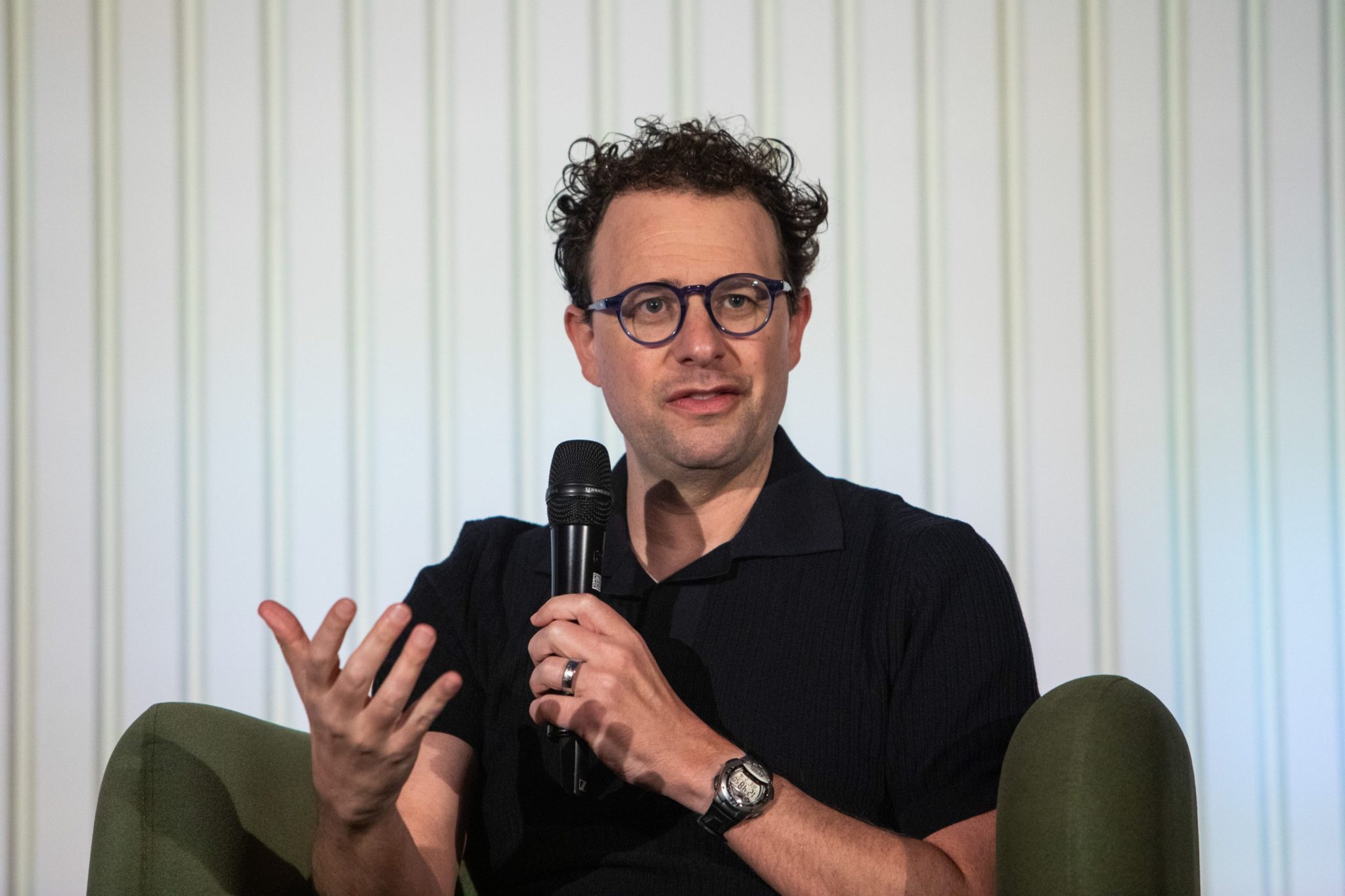
Eric Vaughan, CEO of enterprise-software powerhouse IgniteTech, was unwavering as he reflected on the most radical decision of his decades-long career. In early 2023, convinced generative AI was an “existential” transformation, Vaughan looked at his team and saw a workforce not fully on board. His ultimate response: He ripped the company down to the studs, replacing nearly 80% of staff within a year, according to headcount figures reviewed by Fortune.
Over the course of 2023 and into the first quarter of 2024, Vaughan told Fortune, IgniteTech replaced hundreds of employees, declining to disclose a specific number. “That was not our goal,” he told Fortune. “It was extremely difficult … But changing minds was harder than adding skills.” It was, by any measure, a brutal reckoning—but Vaughan insists it was necessary, and said he’d do it again.
For Vaughan, the writing on the wall was clear and dramatic.
“In early 2023, we saw the light,” he told Fortune in an August 2025 interview, adding he believed every tech company was facing a crucial inflection point around adoption of artificial intelligence. “Now I’ve certainly morphed to believe that this is every company, and I mean that literally every company, is facing an existential threat by this transformation.”
Where others saw promise, Vaughan saw urgency—believing failing to get ahead on AI could doom even the most robust business. He called an all-hands meeting with his global remote team. Gone were the comfortable routines and quarterly goals. Instead, his message was direct: Everything would now revolve around AI. “We’re going to give a gift to each of you. And that gift is tremendous investment of time, tools, education, projects … to give you a new skill,” he explained. The company began reimbursing for AI tools and prompt-engineering classes, and even brought in outside experts to evangelize.
“Every single Monday was called ‘AI Monday,’” Vaughan said, with his mandate for staff that they could work only on AI. “You couldn’t have customer calls; you couldn’t work on budgets; you had to only work on AI projects.” He said this happened across the board, not just for tech workers, but also for sales, marketing, and everybody else at IgniteTech. “That culture needed to be built. That was the key.”
This was a major investment, he added: 20% of payroll was dedicated to a mass-learning initiative, and it failed because of mass resistance, even sabotage. Belief, Vaughan discovered, is a hard thing to manufacture.
“In those early days, we did get resistance, we got flat-out, ‘Yeah, I’m not going to do this’ resistance,” he said. “And so we said goodbye to those people.”
The pushback: white collar resistance
Vaughan was surprised to find it was often the technical staff, not marketing or sales, who dug in their heels. They were the “most resistant,” he said, voicing various concerns about what the AI couldn’t do, rather than focusing on what it could. The marketing and salespeople were enthused by the possibilities of working with these new tools, he added.
This friction is borne out by broader research. According to the 2025 enterprise AI adoption report by Writer, an agentic AI platform for enterprises, one in three workers say they’ve “actively sabotaged” their company’s AI rollout—a number that jumps to 41% of millennial and Gen Z employees. This can take the form of refusing to use AI tools, intentionally generating low-quality outputs, or avoiding training altogether. Many act out because of fears that AI will replace their jobs, while others are frustrated by lackluster AI tools or unclear strategy from leadership.
Writer’s chief strategy officer Kevin Chung told Fortune the “big eye-opening thing” from this survey was the human element of AI resistance.
“This sabotage isn’t because they’re afraid of the technology,” he said. “It’s more like there’s so much pressure to get it right, and then when you’re handed something that doesn’t work, you get frustrated.”
He added Writer’s research shows workers often don’t trust where their organizations are headed.
“When you’re handed something that isn’t quite what you want, it’s very frustrating, so the sabotage kicks in, because then people are like, ‘Okay, I’m going to run my own thing. I’m going to go figure it out myself.’” You definitely don’t want this kind of “shadow IT” in an organization, he added.
Vaughan said he didn’t want to force anyone.
“You can’t compel people to change, especially if they don’t believe,” he said, adding belief was really the thing he needed to recruit for.
Company leadership ultimately realized they’d have to launch a massive recruiting effort for what became known as “AI innovation specialists.” This applied across the board: to sales, finance, marketing, and elsewhere. Vaughan said this time was “really difficult” as things inside the company were “upside down … We didn’t really quite know where we were or who we were yet.”
A couple of key hires helped, starting with the person who became IgniteTech’s chief AI officer, Thibault Bridel-Bertomeu. That led to a full reorganization of the company that Vaughan called “somewhat unusual.” Essentially, every division came to report into the AI organization, regardless of domain.
This centralization, Vaughan said, prevented duplication of efforts and maximized knowledge sharing—a common struggle in AI adoption, where Writer’s survey shows 71% of the C-suite at other companies say AI applications are being created in silos and nearly half report their employees have been left to “figure generative AI out on their own.”
No pain, no gain?
In exchange for this difficult transformation, IgniteTech reaped extraordinary results. By the end of 2024, the company had launched two patent-pending AI solutions, including a platform for AI-based email automation (Eloquens AI), with a radically rebuilt team.
Financially, IgniteTech remained strong. Vaughan disclosed the company, which he said was in the nine-figure revenue range, finished 2024 at “near 75% Ebitda”—all while completing a major acquisition, Khoros.
“You multiply people … give people the ability to multiply themselves and do things at a pace,” he said, touting the company’s ability to build new customer-ready products in as little as four days, an unthinkable timeline in the old regime. In the months since, Vaughan told Fortune in an early 2026 statement, the company has only kept growing its headcount, recruiting globally for AI Innovation Specialists across every function, from marketing to sales to finance to engineering to support.
What does Vaughan’s story say for others? On one level, it’s a case study in the pain and payoff of radical change management. But his ruthless approach arguably addresses many challenges identified in the Writer survey: lack of strategy and investment, misalignment between IT and business, and the failure to engage champions who can unlock AI’s benefits.
The ‘boy who cried wolf’ problem
To be sure, IgniteTech is far from alone in wrestling with these challenges. Joshua Wöhle is the CEO of Mindstone, a firm that provides AI upskilling services to workforces, training hundreds of employees monthly at companies including Lufthansa, Hyatt, and NBA teams. He recently discussed the two approaches described by Vaughan—upskilling and mass replacement—in an appearance on BBC Business Today.
Wöhle contrasted the recent examples of Ikea and Klarna, arguing the former’s example shows why it’s better to “reskill” existing employees. Klarna, a Swedish buy-now, pay-later firm, drew considerable publicity for a decision to reduce members of its customer support staff in a pivot to AI, only to rehire for the same roles.
“We’re near the point where [AI is] more intelligent than most people doing knowledge work. But that’s precisely why augmentation beats automation,” Wöhle wrote on LinkedIn.
A representative for Klarna told Fortune the company did not lay off employees, but has instead adopted several approaches to its customer service, which is managed by outsourced customer service providers who are paid according to the volume of work required. The launch of an AI customer service assistant reduced the workload by the equivalent of 700 full-time agents—from roughly 3,000 to 2,300—and the third-party providers redeployed those 700 workers to other clients, according to Klarna. Now that the AI customer service agent is “handling more complex queries than when we launched,” Klarna says, that number has fallen to 2,200. Klarna says its contractor has rehired just two people in a pilot program designed to combine highly trained human support staff with AI to deliver outstanding customer service.
In an interview with Fortune, Wöhle said one client of his has been very blunt with his workers, ordering them to dedicate all Fridays to AI retraining, and if they didn’t report back on any of their work, they were invited to leave the company.
He said it can be “kinder” to dismiss workers who are resistant to AI: “The pace of change is so fast that it’s the kinder thing to force people through it.” He added he used to think if he got all workers to really love learning, then that could help Mindstone make a real difference, but he discovered after training literally thousands of people that “most people hate learning. They’d avoid it if they can.”
Wöhle attributed much of the AI resistance in the workforce to a “boy who cried wolf” problem from the tech sector, citing NFTs and blockchain as technologies that were billed as revolutionary but “didn’t have the real effect” that tech leaders promised.
“You can’t really blame them” for resisting, he said. Most people “get stuck because they think from their work flow first,” he added, and they conclude AI is overhyped because they want AI to fit into their old way of working. “It takes a lot more thinking and a lot more kind of prodding for you to change the way that you work,” but once you do, you see dramatic increases. A human can’t possibly keep five call transcripts in their head while you’re trying to write a proposal to a client, he offers, but AI can.
Ikea echoed Wöhle when reached for comment, saying its “people-first AI approach focuses on augmentation, not automation.” A spokesperson said Ikea is using AI to automate tasks, not jobs, freeing up time for value-added, human-centric work.
The Writer report notes companies with formal AI strategies are far more likely to succeed, and those who heavily invest in AI outperform their peers by a large margin. But as Vaughan’s experience shows, investment without belief and buy-in can be wasted energy. “The culture needed to be built. Ultimately, we ended up having to go out and recruit and hire people that were already of the same mind. Changing minds was harder than adding skills.”
From the vantage point of early 2026, Vaughan reflected in a statement to Fortune, monthly all-hands meetings look nothing like they used to: “We killed the format of reviewing goals and metrics. Now teams demo what they built.” He wanted to stress something else: Despite the drastic actions he took to restructure, he still doesn’t think he’s ahead of the curve.
“We’re just not getting run over from behind yet,” he said. “The pace of change in AI is relentless. If we don’t keep pushing, keep learning every single day, we’re toast.”
For Vaughan, there’s no ambiguity. Would he do it again? He doesn’t hesitate: He’d rather endure months of pain and build a new, AI-driven foundation from scratch than let an organization drift into irrelevance.
“This is not a tech change. It is a cultural change, and it is a business change,” he said, adding he doesn’t recommend others follow his lead and swap out 80% of their staff.
“I do not recommend that at all,” he said. “That was not our goal. It was extremely difficult.”
But at the end of the day, he added, everybody’s got to be in the same boat, rowing in the same direction. Otherwise, “we don’t get where we’re going.”
A version of this story was published on Fortune.com on August 17, 2025.
More on AI in the workplace:
Credit: Source link